

The Connected Society – and the Feeling of Being Left Out
The Connected Society
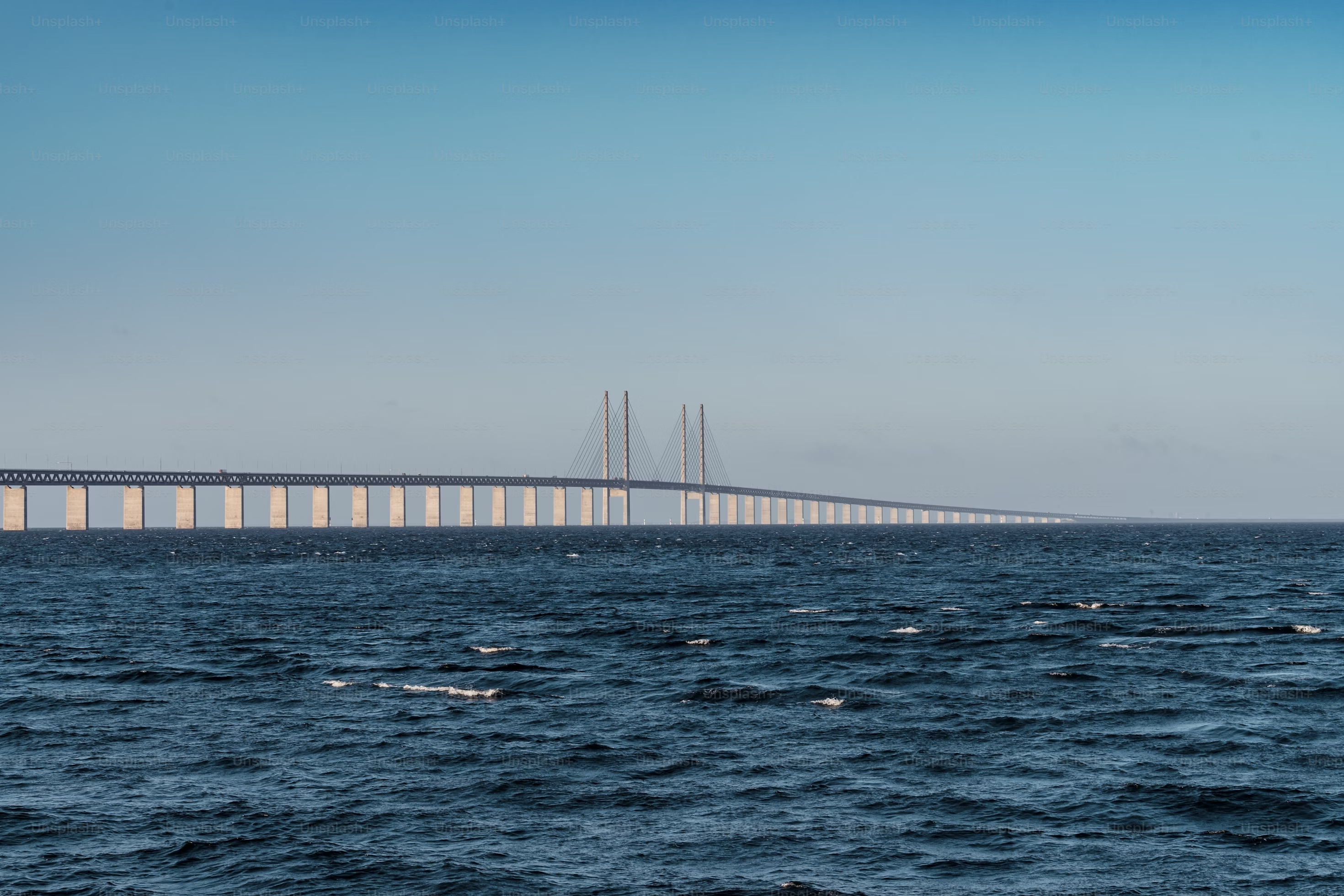
On a recent Saturday, Denmark experienced a quiet collapse. A glitch at a single IT supplier triggered a domino effect: Nets, MitID, NemID, payment terminals, public transport systems, and even gas stations went offline. The chaos at the Great Belt Bridge became a symbol – not just of digital vulnerability, but of the invisible complexity that rules our lives.
Everyday life today is a mental obstacle course. One app demands another. Passwords, updates, two-step verifications, browser restrictions – all to pay a bill or check your mailbox. You spend hours fixing things you never asked to be broken.
It’s not just annoying. It’s exhausting. And alienating.
In theory, everything works. In practice, we fear logging out – what if something breaks? We joke about it. But deep down, it’s not funny. It’s a creeping unease: a sense that the systems we rely on weren’t built with us in mind. Or worse – that they no longer need us.
This isn’t just a tech issue. It’s existential.
We become strangers in our own society. For every new update or digital service, more people feel left behind. We’re told it’s progress. But when you can’t access your bank, retrieve your documents, or pick up your child – is that really progress?
A Sociological Reality
The phenomenon has a long academic lineage. As early as the 1980s and ’90s, thinkers like Manuel Castells, Ulrich Beck, Anthony Giddens, and Niklas Luhmann described the emergence of a network society – a shift from industrial structures to systems defined by complexity, reflexivity, and hyper-connectivity.
- Castells saw the rise of “network logic” as a new social order, where nodes replace hierarchies, and flows of information become more powerful than institutions.
- Beck described the risk society – where modern systems create new types of manufactured uncertainties: global, technical, untraceable.
- Giddens introduced the concept of disembeddedness – how modern life increasingly relies on systems we can’t see or control, stretching trust across time and space.
- Luhmann, perhaps the most radical of them, claimed society was no longer structured by people, but by self-referential systems – communication loops so complex they lose sight of human needs entirely.
These aren’t abstract ideas anymore. They're Tuesday morning. They're your locked MitID. Your unreadable QR code. The helpdesk that says “try again later.”
What we are seeing is a practical breakdown of trust – not because people dislike technology, but because they are excluded from understanding or influencing it. The connected society, in its current form, does not offer empowerment. It offers delegation without clarity. Responsibility without access. Speed without resilience.
The Illusion of Control
The real danger isn’t that systems fail – they always will. It’s that we pretend otherwise. That we’ve allowed public and private institutions to adopt digital infrastructures with blind optimism and no real accountability.
Today, there is no app, no platform, no “solution” that functions independently. Each is a patchwork of APIs, vendors, sub-contractors, and cross-border data dependencies. And yet, companies and governments act as if they are in full control. They’re not. And the gap between that illusion and lived experience is growing.
So what do we do?
Individually: Stay calm. Expect things to break. Laugh when systems fail – and remember: you’re not the problem. You’re just trying to live in a system that wasn’t built for ordinary humans. The frustration is rational. The confusion is designed in.
Collectively: We need to move beyond buzzwords. A society run on “digital solutions” must ask better questions: Does it work? Who’s responsible? Can a citizen understand it? And most of all – are there real people on the other end?
Because without human faces – and without the courage to design for complexity instead of hiding it – the connected society will keep disconnecting those it was meant to serve.
The goal of modern infrastructure should not be perfection. It should be resilience with empathy. A system that bends before it breaks. A network that doesn’t just serve the fastest – but includes the slowest.
That’s not just technological progress. That’s civilisation.